
Grab is a profitable, dominant super-app platform in one of the world's highest-growth regions, trading at a discount while scaling operating leverage and free cash flow, just as Palantir did before the market woke up to its commercial flywheel.
Dear Growth Investos,
I live in Taiwan 🇹🇼 and use FoodPanda almost every day. Grab expanded into its 9th market with the $600 million acquisition of foodpanda Taiwan from Delivery Hero, expected to close in H2 2026. Also whenever I travel to Thailand or Vietnam, I immediately switch to Grab. To me, the app has become indispensable and has deeply integrated itself into daily life.
👉 That personal experience is exactly why I believe $GRAB today is sitting where $PLTR was in 2022: dominant platform, strong fundamentals, ignored by the market, with multi-year compounding potential ahead.
DISCLAIMER: This review is for informational and educational purposes only and does not constitute financial or investment advice. I hold a position in Grab at the time of writing. All data is sourced from publicly available filings, press releases, and market research. Past performance is not indicative of future results. Investing in stocks involves substantial risk of loss. DYOR!
Stock Performance
🔴 5 years: 🔻-67%
🔴 1 year: 🔻 -35%
🔴 3 months: 🔻 -17%
🔴 My position: 🔻 -24% (€4,05 average price)
The underperformance was primarily about the following reasons:
• Indonesia's Rule Change: Indonesia is one of Grab's biggest markets. The government capped ride-hailing fees at 8%, which hurt Grab Holdings' profit margins.
• Investor Focus on AI: Investors moved their money to US tech companies building AI. Grab does not build AI hardware, so it was left out of this big trend.
• The pending GoTo acquisition is a major factor: Talks for Grab to acquire or merge with GoTo have been ongoing since late 2025.
Why I will add to my position ❗
👉 Grab isn’t just rides and food, it’s payments, insurance, grocery, lending, and more, all in one seamless wallet. During my recent trips across Thailand and Vietnam, the density of drivers, speed of delivery, and overall reliability stood out. The network effects are real and widening.
👉 With 50M+ monthly active users, Grab still has huge under-penetration runway across Southeast Asia. Many local competitors are unprofitable and burning cash.
Financials
Grab Holdings Limited reported its Q1 2026 results on May 5, 2026 (for the quarter ended March 31, 2026).
Key Q1 2026 Highlights
Revenue: $955 million (+24% YoY, or +19% on constant currency basis), beating consensus estimates.
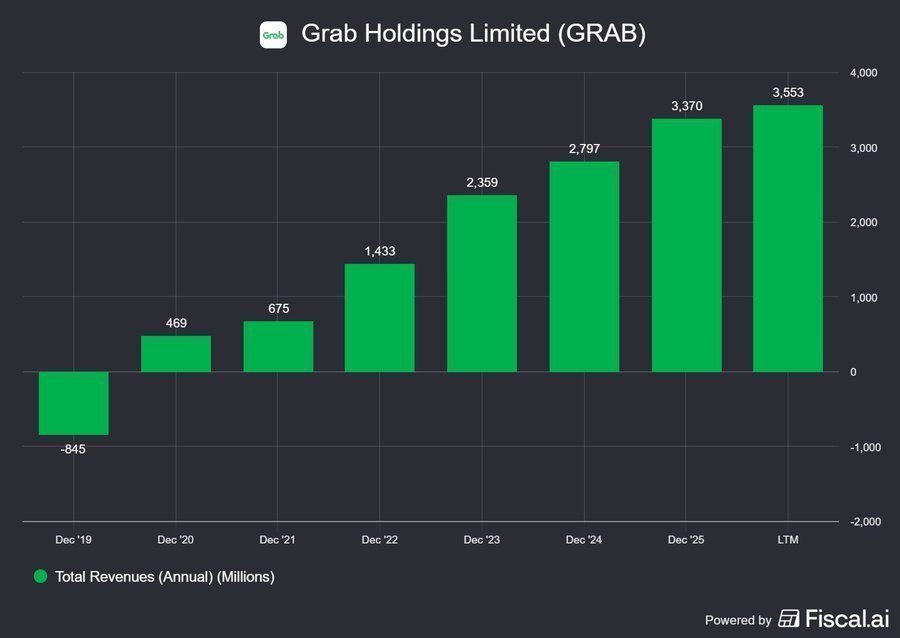
On-Demand GMV (Mobility + Deliveries): $6.1 billion (+24% YoY, or +21% constant currency).
Profit for the period: $120 million (vs. $10–24 million in Q1 2025; strong growth driven by operating leverage, fair value gains, etc.).
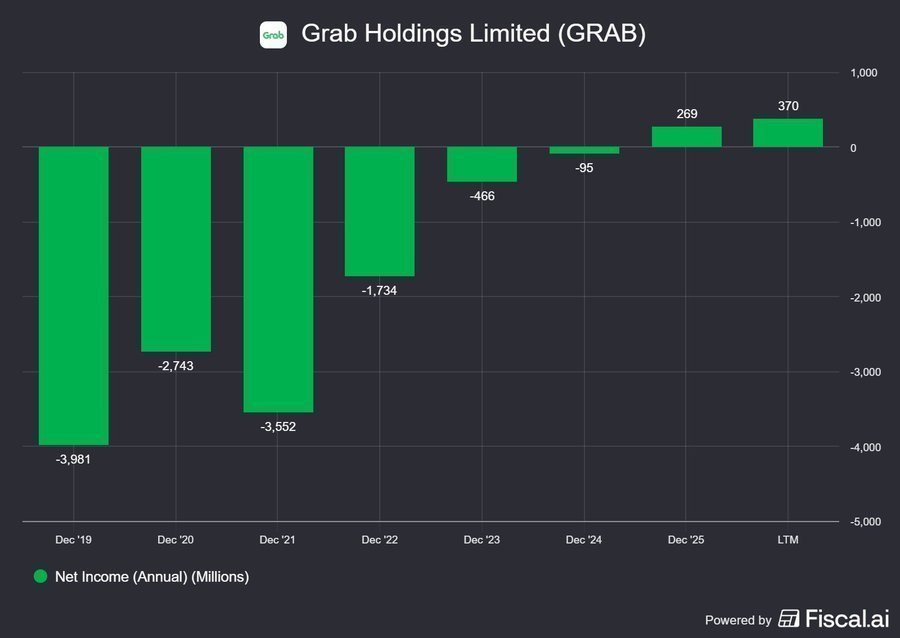
Adjusted EBITDA: $154 million (+46% YoY), beating estimates (~$146 million expected); margin expanded to 16.2% of revenue (from 13.7%).
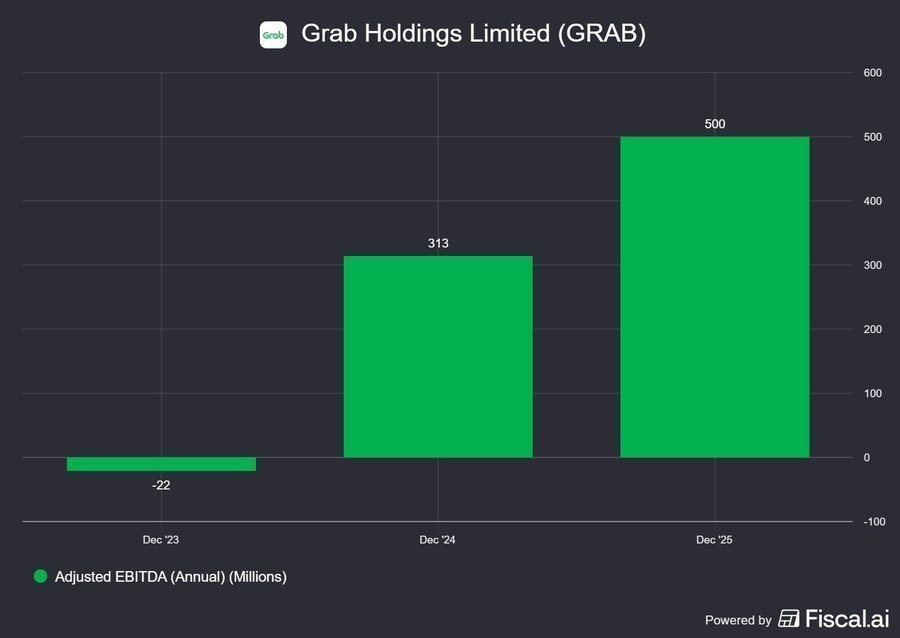
Group MTUs: 51.6-52 million (+16% YoY).
Adjusted Free Cash Flow (trailing 12 months): $489 million.
Other notes: Total incentives rose due to festive periods and fuel costs (On-Demand incentives at 10.5% of GMV). Regional corporate costs increased. Gross cash liquidity: $6.9 billion; net cash liquidity: $5.0 billion. Share repurchase activity ongoing.
Segment Breakdown (Q1 2026)
Deliveries: Revenue $510 million (+23% YoY); GMV $3.908 billion (+25% YoY). Segment Adj. EBITDA margin on GMV: 2.3% (improved). Strong ad growth.
Mobility: Revenue $337 million (+19% YoY); GMV $2.223 billion (+23% YoY). Segment Adj. EBITDA margin on GMV: 8.9%. Driver-partner growth and EV/cross-border initiatives.
Financial Services: Revenue $107 million (+43% YoY). Gross loan portfolio $1.438 billion (+130% YoY); loans disbursed >$1.1 billion (+67% YoY). Segment Adj. EBITDA: -$17 million (improved from -$30 million). On track for H2 2026 breakeven.
👉 Note on GAAP EPS: Reports showed a small loss (e.g., -$0.01) in some adjusted/consensus views, but overall profitability improved significantly.
2026 Full-Year Outlook / Guidance (Reiterated, Unchanged)
• Group Revenue: $4.04 billion to $4.10 billion (implying ~20 to 22% YoY growth).
• Adjusted EBITDA: $700 million to $720 million (implying ~40 to 44% YoY growth).
Management commentary 💬: Q1 was seasonally soft but showed resilience. They view Q1 incentives as a peak; guidance assumes operating leverage and AI-driven efficiencies will support sequential improvement. Focus remains on profitable growth, capital returns (e.g., buybacks), and ecosystem support amid fuel/regulatory pressures.
💬 @topsecretstocks: "What really stand out is that Grab achieved a major milestone in 2025: its first full-year net profit of approximately $200 million on $3.37 billion in revenue (roughly +20% YoY growth). It also reported around $500 million in adjusted EBITDA with 50.5 million monthly transacting users."
Innovations
Beyond its core aggregator model, Grab has aggressively pursued innovations in technology and business expansion. Two standout areas are financial engineering through acquisitions and autonomous driving (AV).
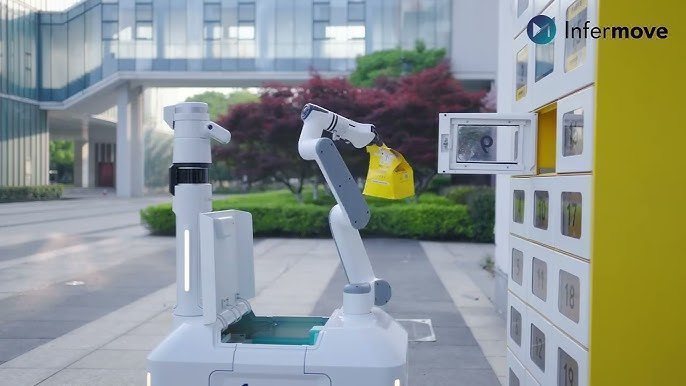
Infermove (announced December 2025): Grab acquired this China-based developer of AI-enabled robotics solutions. The move strengthens first- and last-mile delivery capabilities through automation, improving efficiency, reducing operational costs, and scaling delivery operations without proportional increases in human labor.
Stash Financial, Inc. (announced February 12, 2026; closed July 1, 2026): Grab acquired 100% of this U.S. digital investing platform in a deal structured around a $425 million enterprise value for the initial 50.1% stake (paid in cash and stock at closing), with the remainder at fair market value over three years. Stash brings $5 billion in assets under management (AUM), over 1 million paying subscribers, and is already Adjusted EBITDA and cash-flow-positive. It is projected to generate more than $60 million in Adjusted EBITDA by 2028. Stash operates as an independent U.S. brand with its existing team, while Grab gains talent, technology (including AI-powered tools like its Money Coach), and high-margin recurring subscription revenue. Longer-term, Grab plans to explore rolling out Stash’s investing solutions in Southeast Asia. This deal accelerates Grab’s financial services roadmap and diversifies revenue beyond its core Southeast Asian operations.
foodpanda Taiwan (announced March 23, 2026): Grab agreed to acquire Delivery Hero’s foodpanda delivery business in Taiwan for $600 million cash (cash-free, debt-free basis), with closing expected in H2 2026 (subject to approvals). This marks Grab’s expansion into its 9th market and its first major footprint outside Southeast Asia. It significantly bolsters Grab’s delivery scale in Taiwan (across multiple cities) and is expected to contribute positively to future EBITDA.
💬 @topsecretstocks: "These acquisitions reflect Grab’s strategy of using its strong balance sheet to buy scale, technology, and new revenue streams while maintaining focus on core Southeast Asian markets. They help improve margins, diversify geographically and by segment (fintech + automated delivery), and position the company for compounded growth."
Also Grab is actively pioneering autonomous vehicles (AVs) to tackle regional mobility challenges, dense traffic, mixed vehicle types (including motorcycles), varying road quality, and gaps in first/last-mile connectivity in neighborhoods, industrial zones, and campuses.
Key milestones and projects:
July 2025: Grab launched its first internal autonomous electric shuttle bus service for employees. This prototype connected Grab’s headquarters to the one-north MRT station in Singapore, using technology from South Korean partner Autonomous A2Z. It served as a controlled testbed for real-world operations.
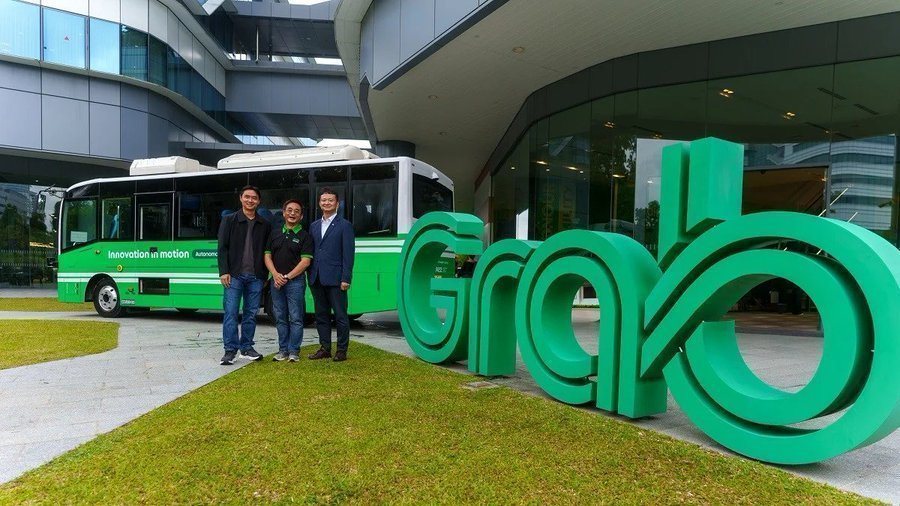
April 1, 2026: Grab and Chinese AV leader WeRide officially launched Singapore’s first autonomous public passenger service inside a residential estate (Punggol). The Ai.R (Autonomously Intelligent Ride) service operates publicly using WeRide’s vehicles: GXR (5-seater robotaxi-style), Robobus (8-seater shuttle).

Rides are bookable via the Grab app (with reservation options on some routes), feature advanced 360° sensors (detecting objects up to 200 meters), and include remote safety support. The service connects neighborhoods to transport nodes and key destinations. It has accumulated over 45,000 km of autonomous travel.
Additional partnerships include Motional and Singapore-based Zelos. Grab has also made significant investments in the AV ecosystem, including a notable $60 million strategic investment in German remote-driving technology company Vay.

Strategic goals:
Fill service gaps where traditional rides are less efficient.
Complement public transport, especially off-peak or in lower-density areas.
Gather localized data to adapt AVs to Southeast Asia’s unique conditions (e.g., two-wheelers, unpredictable traffic).
Long-term: Reduce driver dependency, lower costs, improve accessibility/safety, and scale efficient mobility solutions across the region.
💬 @topsecretstocks: "The Ai.R service demonstrates Grab’s ability to move from internal testing to public deployment quickly, leveraging partnerships with global AV leaders while tailoring solutions locally."
I also want to highlight out the AI and Ecosystem: Grab complements the efforts above with heavy investment in AI. At its GrabX 2026 event, it unveiled 13 new AI-powered features spanning consumer personalization, merchant tools (e.g., menu setup, marketing, finance), driver assistance, and travel planning, all powered by in-house infrastructure and partnerships (including OpenAI and Anthropic).
👉 These innovations reinforce Grab’s evolution into an “everyday guide” while driving efficiency and new monetization opportunities.
Outlook
Grab’s innovations, particularly acquisition-driven financial expansion (Stash for high-margin fintech, foodpanda Taiwan for delivery scale, Infermove for robotics) and real-world autonomous driving deployments (Ai.R public service), highlight a dual focus on immediate profitability and long-term technological leadership.
With a proven path to profitability, a strong cash position, and targeted bets on AI, robotics, and AVs, Grab is positioning itself as a regional tech powerhouse capable of exporting capabilities (e.g., AV insights or fintech tools) while deepening its superapp dominance in Southeast Asia and selectively expanding beyond.
These moves underscore Grab’s mission of economic empowerment through technology, making daily life more convenient, efficient, and accessible while building sustainable shareholder value. As regulatory frameworks mature and technologies prove themselves in complex environments like Singapore, further scaling of autonomous and automated solutions appears likely.
Now the most exciting part: The Palantir Parallel

In 2022, Palantir traded in a tight range around $6 to $10 after its direct listing. Critics called it overvalued, government-heavy, with sluggish commercial traction and high stock-based compensation. Many dismissed the "software platform" narrative as marketing fluff. Yet underneath, commercial revenue was accelerating, bootcamps were converting users into sticky contracts, and the company was building an AI moat with its ontology and forward-deployed engineers.
Fast-forward: by 2025 to 2026, Palantir's stock had multiplied dramatically as the market finally priced in its shift to high-margin, scalable commercial growth and AI leadership.
💬 @topsecretstocks: "Grab sits in a strikingly similar "quiet compounding" phase today."
Q1 2026: Revenue +24% YoY to . On-Demand GMV +24% to . Adjusted EBITDA +46% to $154M (record). Net profit $120M
Full-year 2025: First full-year net profit (~$200M+), with strong momentum into 2026.
Guidance: 2026 revenue $4.04 to 4.10B (~20 to 22% growth), Adj. EBITDA $700 to 720M (+40 to 44%). Trailing free cash flow scaling nicely (hundreds of millions).
💬 @topsecretstocks: "This disconnect feels very 2022 Palantir: strong fundamentals overshadowed by macro caution, emerging-market discount, and slower near-term hype versus pure-play AI names."
Grab bundles everything into one seamless experience with high engagement:
Dominant market position: ~55%+ share in mobility & deliveries across SEA, often 70 to 90%+ in key countries (e.g., Malaysia, Philippines, Singapore). Gojek/GoTo is the main rival but trails significantly.
Network effects are powerful: more riders attract more drivers, data improves routing/pricing/ETAs, cross-selling boosts retention (e.g., a ride user trying food delivery or fintech).
User base: Tens of millions of monthly transacting users, with room to grow penetration in a region of 700M+ people where formal banking, logistics, and on-demand services remain under-penetrated.
💬 @topsecretstocks: "This mirrors Palantir's platform stickiness, once integrated, it's hard to rip out, and usage compounds."
Risks and Why Patience Matters
No parallel is perfect. Grab faces:
Regulatory/gig worker issues in some markets.
Macro sensitivity in emerging Asia (currency, consumption).
Execution risk in fintech scaling.
💬@topsecretstocks: "Like Palantir's 2022/2023 phase, the market may need several more quarters of consistent beats, margin expansion, and capital returns (buybacks, eventual dividends) before a sustained re-rating. Sentiment can lag fundamentals for years in overlooked compounders."
Bottom line: Grab is a profitable, dominant super-app platform in one of the world's highest-growth regions, trading at a discount while scaling operating leverage and free cash flow, just as Palantir did before the market woke up to its commercial flywheel.