
Dear $ASTS Investors,
A single executive hire did send shockwaves through investor communities. T-Mobile $TMUS announced that wireless industry veteran Chris Sambar would join as Chief Enterprise Officer, effective no later than October 14, 2026. He joins from his role as Chief Operating Officer at Public Storage and brings more than two decades of experience from AT&T.
Simultaneously, long-time T-Mobile executive Mike Katz, who had been elevated to Chief Business & Product Officer, announced he is stepping away to pursue new professional interests while serving in a strategic advisory capacity through December 2026.
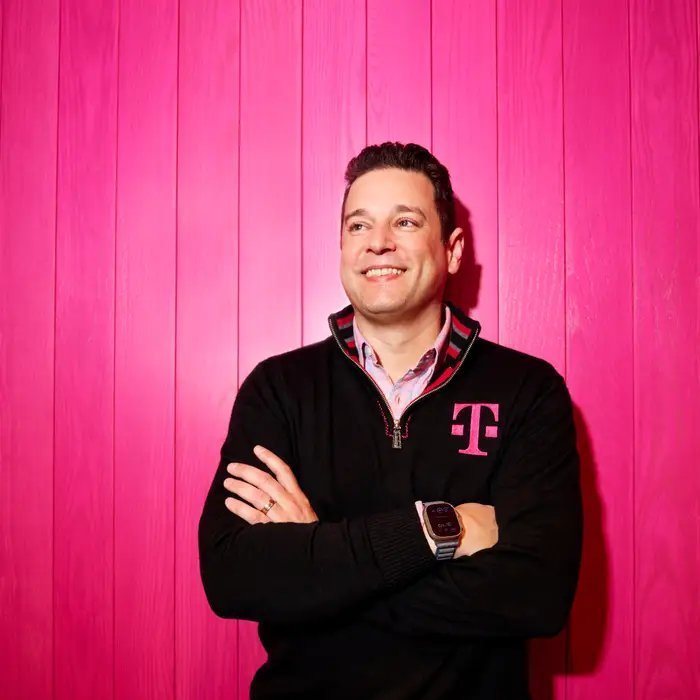
These moves, occurring against the backdrop of a May 2026 joint venture announcement by AT&T, Verizon, and T-Mobile to tackle U.S. mobile dead zones with satellite direct-to-device (D2D) technology, have ignited a firestorm of speculation.
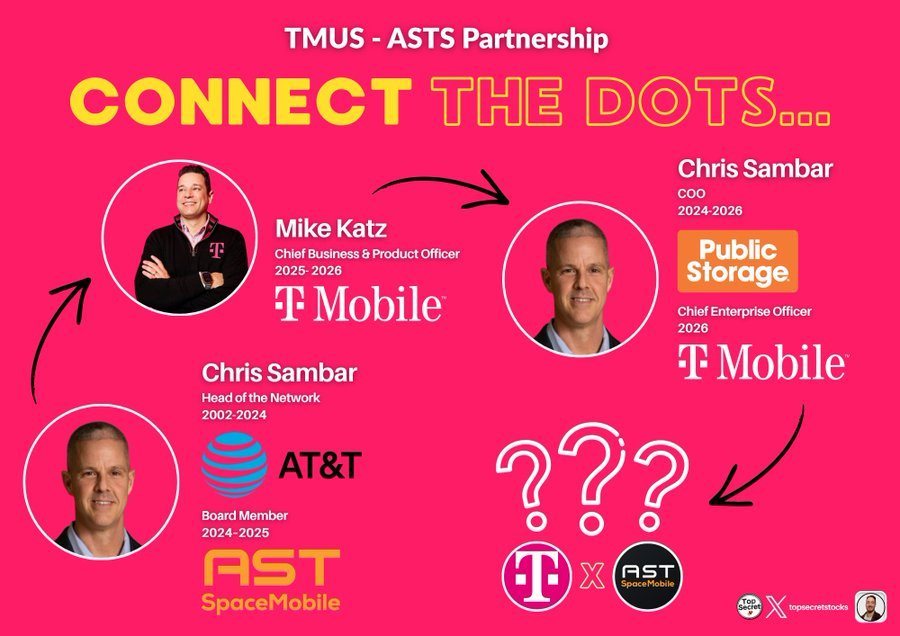
Sambar joined the AST board in June 2024 while still at AT&T, helped deepen the AT&T-ATS relationship (definitive agreement announced May 2024), resigned from the AST board on January 29, 2025 (explicitly not due to disagreement), moved to Public Storage, and now lands at T-Mobile in a senior role overseeing enterprise, SMB, government, and emerging growth opportunities.
Investors are asking: "Why would T-Mobile bring in someone with such deep, hands-on experience with AST SpaceMobile’s D2D technology precisely when the industry is accelerating satellite integration?"
Let's go back in history for answering that question...
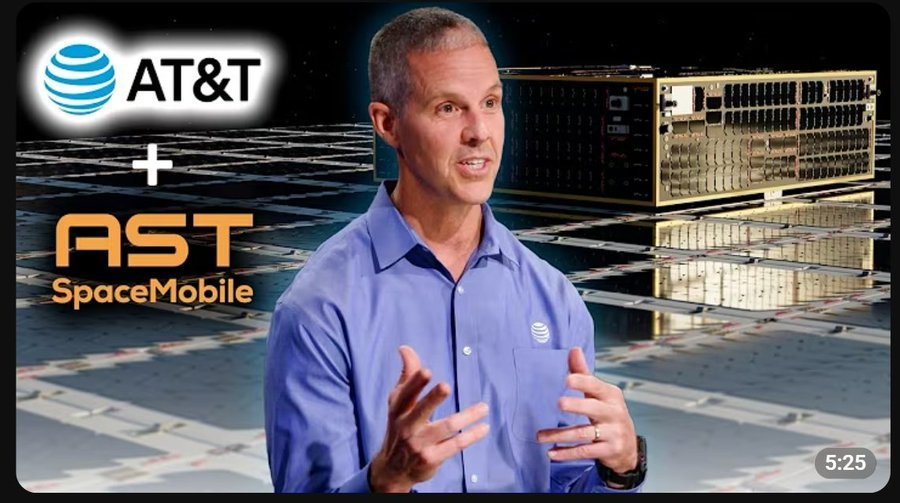
Source: https://www.youtube.com/watch?v=PxFtRR1GUlc
This 5:25-minute 2022 partner profile video from AST SpaceMobile features Chris Sambar. He discusses AT&T's long-standing collaboration with AST SpaceMobile (starting in 2018) to build a space-based cellular broadband network. The goal is to complement AT&T's terrestrial network, filling coverage gaps in remote/rural areas, on highways, and for first responders, businesses, and consumers, using standard, unmodified cell phones connected directly to low-Earth-orbit satellites.
Key Quotes from Chris Sambar
On coverage challenges and the opportunity: “For a wireless carrier, there's some really challenging areas to cover in America. So, we're always looking for new, unique, different solutions. ... the potential to integrate a mobile wireless network like we have and a direct-to-cell network of AST, I can carry any cell phone and it can be connected to the satellite network. What a terrific opportunity.”
Introducing himself and AT&T's scale/mission: “My name is Chris Sambar, I'm the president of AT&T Network. ... We have the largest wireless network in America. We cover more square miles than any other wireless company. ... AT&T's core mission is connecting people. ... We've been doing it for over 140 years... The reality is it's impossible to cover every square inch of America with any single technology, but we believe we can come really, really close with the combination of terrestrial networks and direct-to-cell satellite networks.”
On the partnership history and technical due diligence: “AST and AT&T have been working on this since 2018. ... We've been working closely together on the project... We had a lot of questions... How [to] compensate for the Doppler effect? You've got a vehicle in space that's traveling 17,000 miles an hour... And we've been really impressed with the AST team... We also visited during the first vehicle that they sent up in space... the BlueWalker 1 experience is what told us that you're really onto something here and the call testing actually worked.”
On BlueWalker 3 and future testing: “In September of 2022, AST launched BlueWalker 3. And we're really excited about the opportunity to test the integration of our terrestrial mobile network with the AST solution. We have a conditional approval today to use AT&T's existing spectrum bands...”
Potential applications (consumers, first responders, etc.): “Just imagine the peace of mind that we can give consumers, first responders after disasters, remote agriculture, remote machinery...” On FirstNet: “...what would mean a lot to us is if we could turn on that connectivity immediately. And the space-based mobile network that AST is building, just imagine the possibility. When they need coverage, it's immediately there. Two-way connectivity, text, voice, data, and even location tracking.”
Personal example of rural coverage gap: “I got a great example... My mother-in-law lives in rural Virginia... there's a stretch of road, and it's not covered by any wireless carrier... Wouldn't it be great if we could cover that little stretch of road with a space-based mobile solution?”
Closing vision: “At AT&T, our goal is to be the best connectivity provider in America. ... The opportunity to extend that network with the network that AST is building, this space-based cellular network, really exciting chance ahead of us.”
Chris Sambar: The Bridge Between Terrestrial Networks and Space
Chris Sambar’s career reads like a roadmap for modern wireless leadership. Over roughly 22 years at AT&T, he rose to Head of Network, overseeing the buildout of the company’s 5G infrastructure, corporate strategy, enterprise sales, and the landmark FirstNet public safety network.
In June 2024, while still at AT&T, Sambar was appointed to AST SpaceMobile’s Board of Directors (as a designee linked to AT&T interests) and joined the Network Planning & Spectrum Committee. He became one of the most visible and enthusiastic external advocates for AST technology. He participated in joint events and interviews with AST SpaceMobile CEO Abel Avellan, visited the company’s facilities in Midland, Texas, and publicly praised the solution for addressing “really challenging areas to cover in America.”
His involvement coincided with (and likely supported) the May 15, 2024, announcement of a definitive commercial agreement between AT&T and AST SpaceMobile. The deal, running through 2030, aims to deliver space-based cellular broadband directly to standard smartphones, complementing AT&T’s terrestrial network and eliminating dead zones in wilderness areas, national parks, rural highways, and hard-to-reach locations.
Sambar resigned from the AST board in late January 2025 after departing his operational role at AT&T. He then joined Public Storage as COO in October 2024. Now, less than two years later, he returns to telecom at T-Mobile in a C-suite position explicitly tasked with scaling “emerging growth opportunities.”
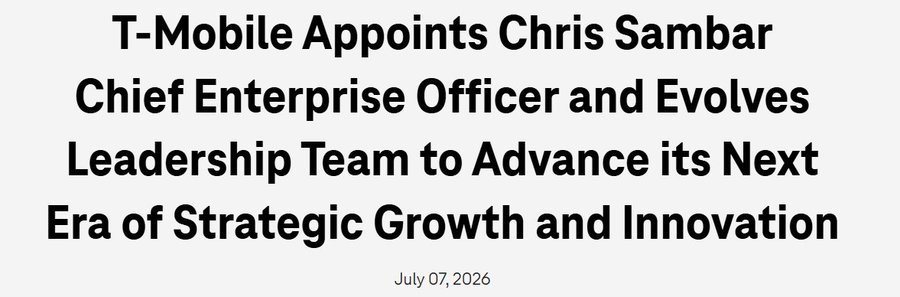
Source: https://www.t-mobile.com/news/business/t-mobile-appoints-chris-sambar-chief-enterprise-officer
T-Mobile’s own press release frames the hire as part of an evolution in leadership to advance “its next era of strategic growth and innovation,” including next-generation networks powered by AI and 6G, and expanding beyond core wireless.
“I am honored to join T‑Mobile’s exceptional leadership team at a time when the company is redefining the industry through bold innovation,” said Sambar. “T‑Mobile’s relentless customer-first spirit is exactly what I believe will define the next generation of business technology and connectivity, and I look forward to helping unlock new growth opportunities while building on the company’s pioneering legacy and track record.”
T-Mobile’s Existing Satellite Play: Starlink Partnership
T-Mobile is not new to satellites. Through its high-profile partnership with SpaceX’s Starlink, the carrier launched T-Satellite (direct-to-cell) service. Initial commercial focus has been on messaging in areas without terrestrial coverage, with expansion into data services underway. Coverage includes the continental U.S., Puerto Rico, Hawaii, parts of Alaska, Canada, New Zealand, and Japan.
Starlink satellites act as “cell towers in space,” using a sliver of T-Mobile’s licensed spectrum. The service has seen strong early adoption, with beta testing attracting millions of sign-ups. It represents a meaningful step toward ubiquitous coverage.
However, satellite D2D is not monolithic. Different technologies, orbits, antenna designs, spectrum strategies, and performance characteristics exist. T-Mobile’s Starlink partnership excels in certain narrowband and supplemental use cases. AST SpaceMobile’s architecture, featuring large phased-array antennas on its BlueBird satellites, targets higher-capacity cellular broadband directly to unmodified consumer phones.
AST SpaceMobile: Building the Space-Based Cellular Broadband Network
AST SpaceMobile is developing what it describes as the first and only space-based cellular broadband network designed to work directly with everyday smartphones (no special hardware required for most use cases). The company has secured agreements with nearly 60 mobile network operators worldwide, representing more than 3 billion subscribers.
Key milestones as of mid-2026:
Successful launch of BlueBird satellites 8, 9, and 10 in June 2026 aboard a SpaceX Falcon 9.
BlueBird 11 is currently on its way from Midland, Texas to Cape Canaveral ahead of next month’s orbital launch.
BlueBirds 12 and 13 will follow soon.
Production continues through BlueBird 38 in Texas.
Goal of approximately 45 BlueBird satellites in orbit by the end of 2026 to enable initial service activation in key markets (U.S., Canada, Europe, Saudi Arabia, Japan, etc.).
Q1 2026 revenue of $14.7 million; full-year 2026 guidance of $150–200 million, driven by mobile network partners and U.S. government contracts.
Partnerships and collaborations with AT&T, Verizon, Vodafone, Rakuten (including a Japan JV), Bell, Telus, stc Group, and others.
Nearly 60 mobile network operators with over 3 billion subscribers.
FCC has granted commercial authorization for D2D supplemental coverage.
The technology relies on low Earth orbit (LEO) satellites equipped with massive antennas to overcome the power and link-budget challenges of connecting to standard phone antennas. This enables not just texting but true broadband capabilities, voice, data, and eventually higher-speed services, in areas where building terrestrial towers is economically or geographically impractical.
The May 2026 Big Three Joint Venture: Industry-Wide Momentum
In May 2026, AT&T, T-Mobile, and Verizon announced plans to form a joint venture focused on satellite-based direct-to-device connectivity to eliminate U.S. mobile dead zones. AST SpaceMobile publicly commended the initiative, noting it aligns with accelerating technical integration and coverage expansion across the wireless industry.
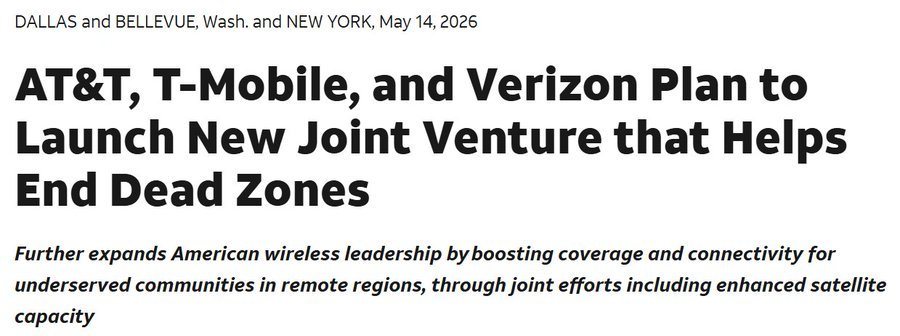
Source: https://about.att.com/story/2026/new-joint-venture.html
Given that AST already has commercial agreements or deep collaborations with AT&T and Verizon, its positioning as a key technology partner for the JV (or parallel bilateral deals) appears logical. T-Mobile, through Sambar’s experience and the broader industry push, now has a clear pathway to similar arrangements.
Why a TMUS-ASTS Partnership Makes Strategic Sense
Complementary Capabilities: T-Mobile’s Starlink deal provides strong initial supplemental coverage. AST could add higher-capacity broadband layers, redundancy, or specialized enterprise features.
Enterprise and Government Focus: Sambar’s new role explicitly includes leading SMB, enterprise, and government businesses while scaling emerging opportunities. His FirstNet experience at AT&T and deep knowledge of public safety, enterprise verticals (energy, logistics, transportation), and spectrum planning make him ideally suited to champion satellite solutions for these high-value segments.
Coverage Ambitions: T-Mobile has long positioned itself as having “America’s Best Network.” Closing remaining dead zones, rural America, national parks, highways, maritime approaches, strengthens that claim and supports 5G/6G evolution.
Competitive Positioning: With AT&T and Verizon already aligned with AST (and now in a JV), T-Mobile risks falling behind if it does not secure similar access. Sambar brings institutional knowledge of how the AT&T deal was structured and executed.
Timing: The leadership transition, the carrier JV, AST’s accelerating constellation deployment (targeting initial service in 2026), and growing revenue visibility create a narrow but powerful window for deal-making.
Potential Deal Structures and Timeline
A $TMUS-$ASTS agreement could mirror the AT&T model: a multi-year commercial pact (through 2030 or beyond) involving prepayments, revenue sharing, technical integration commitments, and possibly spectrum or ground infrastructure elements. It might be bilateral or folded into the broader three-carrier JV framework.
Given Sambar’s start date (no later than mid-October 2026) and ASTS’s launch cadence, any formal announcement could come in late 2026 or early 2027, coinciding with more satellites reaching orbit and initial service milestones.
Market and Stock Implications
For AST SpaceMobile, adding T-Mobile as a major U.S. partner would represent significant validation, accelerate revenue ramp beyond the current $150–200 million 2026 guidance, and strengthen its position as the leading independent D2D broadband provider. It could catalyze further global deals and positive sentiment.
For T-Mobile, enhanced coverage and new enterprise/government revenue streams support its “Un-carrier” differentiation and long-term growth narrative beyond core postpaid wireless. It aligns with the company’s stated focus on innovative technology and emerging opportunities.
Conclusion: The Dots Are Aligning. But Watch for Official Confirmation
The combination of Mike Katz’s transition, Chris Sambar’s arrival with unparalleled relevant experience, T-Mobile’s existing Starlink foundation, the industry-wide push via the three-carrier JV, and AST SpaceMobile’s rapid technical progress creates one of the most intriguing “connect the dots” stories in telecom today.
Sambar is not just any executive, he is someone who has lived the AT&T-AST journey from boardroom advocacy to commercial agreement. Bringing that playbook to T-Mobile’s enterprise and emerging-business organization is a powerful signal.
Whether this leads to a formal partnership announcement, deeper integration through the JV, or simply accelerated technical collaboration remains to be seen. What is clear is that the strategic logic is strong, the timing is opportune, and the personnel alignment is striking.